The S Word: Socialism | John Nichols | Michael Patrick Brady

The S Word: Socialism | John Nichols
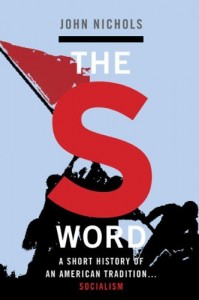
My review of The S Word: A Short History of an American Tradition… Socialism by John Nichols ran today at Popmatters.

:: Order The S Word at Amazon.com ::

The book features six essays exploring how, contrary to the protestations of modern conservatives, socialism played a large role in the development of American culture and politics. There are lots of interesting stories in here, such as the largely indirect relationship (though with one actual, albeit formal, correspondence!) between Abraham Lincoln and Karl Marx, the long reign of municipal socialist mayors in Milwaukee in the first half of the 20th century, and the mainstreaming of socialist concepts and ideals by politicians who felt the need to respond to a growing leftist constituency. Unfortunately, Nichols spends too much time taking shots at easy targets like Sarah Palin and Glenn Beck. The S Word is, in large part, a response to their ill-informed, ignorant mischaracterization of socialism, but there’s little need to dwell on how very wrong they are; to the already left-leaning readers Nichols seems to be targeting with his strident tone, it’s obvious.

Rating: | Michael Patrick Brady

4 Comments Add your own

  • 1. Elaine Schroth  |  June 27th, 2011 at 12:32 am

    Why is it that whenever someone argues or speaks forcefully or with strong conviction on the left, it is called “strident” (as in the above review of “The S Word”? Another favorite word applied to any rhetoric that espouses left or liberal leaning ideas is “shrill” — especially when the speaker is of the female persuasion. On the other hand, these same words are rarely used to describe those on the right, no matter how extreme or obnoxious their ideas may be. Just an observation of something I have noticed over the years.

  • 2. mpb  |  June 27th, 2011 at 7:47 am

    Well, the English major in me wants to say that I used strident to describe someone arguing forcefully because “arguing forcefully” is part of the word’s definition ;) It was not meant to be pejorative, merely descriptive. I tend to reserve words like “repugnant” and “insane” for the right.

  • 3. William Johnson  |  January 1st, 2012 at 1:28 pm

    I understand that you did nt want to be pejorative. But the modifiers that go along with it (i.e., loud, harsh, grating,sharp, strident) are certainly pejorative and I took it that way when I read your review. It may not be the case here but we need to be careful that the terminology of the right doesn’t creep into our own language. The fact that you reserve stronger pejoratives for the right does not excuse using a more mild pejorative to describe Nichols’ tone. I think Elaine made an important point. If Nichols’ argument is forceful then why not call it forceful?

  • 4. mpb  |  January 5th, 2012 at 1:47 pm

    To clarify, while I didn’t mean to be pejorative, I did intend to be critical. I think Nichols’s tone in the book is strident, and I think that tone hurts the book, which has a lot of good information that, unfortunately, won’t reach the people who most need to hear it.

  • Leave a Comment

    (Required)

    (Required, hidden)

    Trackback this post

    Notations»

    05.14.12
    05.06.12

    How did Finland become one of the top educational systems in the world? By focusing on equality, not competition.

    05.05.12
    04.25.12

    “He believes that fairness is defined by market outcomes. To the extent that unfairness exists, it is solely the doing of government: clean energy, laws permitting union dues, overpaid government employees, and so on.” Romney’s perverse ‘fairness.’


    In Rotation

    With the Animals by Noelle RevasOur Lady of Alice Bhatti by Mohammed Hanif

    In the Shadow of Young Girls in Flower - Marcel ProustWish You Were Here - Graham Swift

    Nixonland - Rich PerlsteinGame Change - John Heilemann and Mark Halperin

    Lolita - Vladimir NabokovTraveler of the Century by Andres Neuman

    Norumbega Park by Anthony GiardinaSwann's Way by Marcel Proust, Translated by Lydia Davis